


LAWRENCE “LEAPING LENA”
- 21/08/2023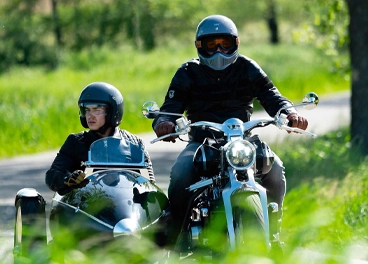
In the splendid *Ultimate Collector Motorcycles* box set published in late March by the luxury book publisher Taschen, Brough Superior takes the lion’s share with no fewer than four machines in this top 100 of extremely rare motorcycles for wealthy collectors, and even five if we include the Aston Martin AMB 001, which brings the two chronological volumes to a close, as it is also produced at the now Toulouse-based headquarters of this former iconic British luxury brand. Brough Superior’s new life is indeed being lived out in the south-west of France, which does not prevent those who now steer the brand’s destiny from continuing the tradition of exceptional quality in the motorcycles bearing the prestigious Brough Superior crest, adored by a certain Lawrence of Arabia. Committed to upholding George Brough’s legacy, whilst adapting the new machines to modern requirements, particularly in terms of emissions standards.
Thierry Henriette had long harboured in a corner of his prolific mind the idea of producing a sidecar, like those that regularly rolled off the production line at the Nottingham factory, notably the incredible “Straight-Four Combination”, which is one of the models selected by Taschen. “Four” for the four in-line cylinders, of course, but also for the wheels, since two parallel wheels positioned almost side by side ensure the vehicle’s stability, in addition to the front wheel and the sidecar wheel. “A third of the Brough Superiors produced before the war were sidecars; they were often used to transport a family, as the engines had plenty of pulling power,” recalls Albert Castaigne, the current director of Brough Superior, whose eyes light up when he talks about the design of the unique sidecar created by the Brough Superior team in Toulouse, based on the modern Lawrence model (the first to meet Euro 5 standards): “Its cigar-shaped sidecar gives it a Zeppelin-like look.” Indeed, the lines of this modern take on the Brough Superior sidecar are a direct nod to the 1930s.
Rémy Lavernhe, a designer at the brand’s Toulouse headquarters, drew inspiration from the “Belle Époque” to sketch out the Art Deco-style contours of the basket. For the construction of the “carriage”, it was Eric, the “magician of metal and welding”, who took on the task, using a titanium sub-frame and an aluminium sheet structure. It took him over 120 hours of work to create this sidecar, which is both stylish and refined.
We took advantage of a few-day window between the vehicle’s formal approval by UTAC and its delivery to the buyer, who hails from the south of France, to ask him if he would allow us to conduct a special test ride for Moto Heroes. With permission granted, we took the reins of Brough Superior’s first sidecar of the modern era and headed for the splendid roads of the Tarn, near the Toulouse factory. The sidecar is very much to the taste of my companion, the aesthete Martin, so much so that he slips inside and feels right at home. I felt the same, because when unladen, the sidecar, driven by the powerful 1000cc twin-cylinder engine, easily unloads its load in right-hand bends, so that you can quickly imagine yourself as Rémy Julienne.
We’ll see later that you can even get Martin to lift off the ground slightly when taking these same bends at a good pace. This goes to show just how well-balanced and responsive the whole thing is, which is remarkable for a one-off vehicle, especially given the multiple constraints of the sidecar. Of course, as with all sidecars, the asymmetrical riding position is more physically demanding than on a conventional two-wheeler, and in this respect the Lawrence’s wide original handlebars are a great help. The leverage is particularly useful in those same right-hand bends, whilst left-hand bends allow for a comfortable lean on the sidecar wheel, which has no brake caliper. Thierry Henriette’s decision to retain the original braking components does not hinder deceleration, thanks to the power of the Beringer system at the front.
Extra bite has been added to the rear wheel to counteract the extra weight caused by the sidecar. Applying firm, simultaneous pressure to the right lever and the right pedal causes the sidecar to veer slightly to the left, but only very moderately, as with any self-respecting sidecar; the bike maintains a straight line when the controls are released without braking. Although the rims, machined in-house at the brand’s headquarters using the new 5-axis machining centre, are extremely lightweight (which notably helps to reduce the load on the sidecar body when cornering), the sidecar still tips the scales at nearly 300 kilos. The additional suspension will work wonders when you venture off the beaten track for a completely impromptu off-road ride.
Anyone accustomed to riding in a sidecar will therefore get the hang of it quickly, so it is hardly surprising that this unique model has been named “Leaping Lena”, a reference to the rich history of speed records. Indeed, in 1932, an Australian named Alan Bruce set a record in Vienna by becoming the first man to break the 200 km/h barrier in a sidecar, riding a Brough Superior sidecar with a 1000cc JAP engine named... Leaping Lena! It’s worth noting that the sidecar was carrying a 65 kg ballast weight in place of a passenger. Roughly the same weight as Martin, who, as I return to the Brough Superior’s seat at a moderate pace, begins to nod off, comfortably settled in his “basket”.